


Matomo vs GA4: The analytics decision UK businesses must make
By: Andy Chapman | Published: 04 December 2025
UK businesses need dependable analytics to guide SEO and marketing decisions. The choice between Google Analytics 4 and Matomo Analytics comes down to competing priorities: ecosystem integration versus data ownership and control. Neither platform is objectively superior. Your choice depends on your business model, budget, and regulatory requirements.
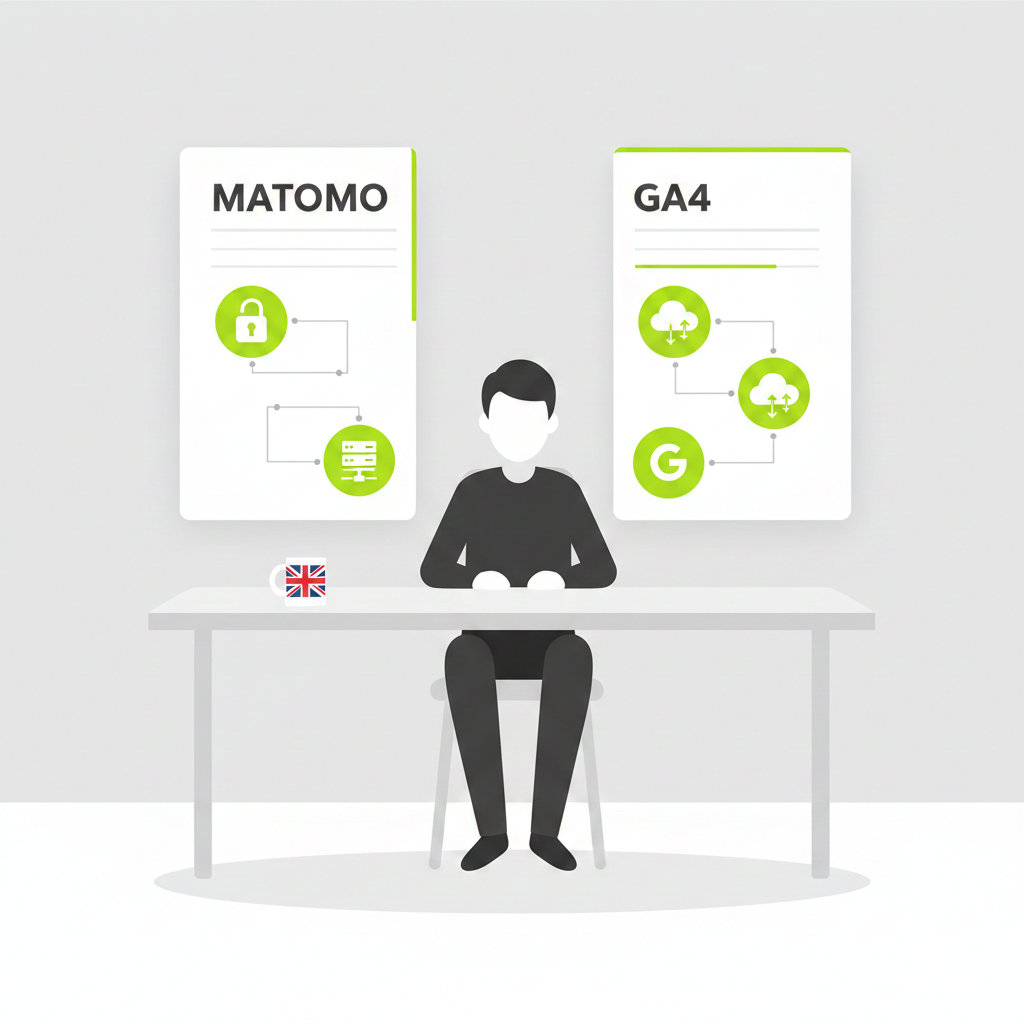
This guide cuts through the marketing noise from both sides and helps you make an informed decision based on what actually matters to your organisation.
Why UK analytics changed after Universal Analytics ended
With the sunset of Universal Analytics, UK and EU organisations were forced to migrate to event-based tracking models. This shift demands intentional configuration, clear visitor consent protocols, and renewed focus on performance-critical insights.
So here's what's changed. You've got to think about GDPR and data transfer rules, which you probably didn't lose sleep over before. And then there's the question of whether your numbers are real or just educated guesses from sampling.
People talk about "clean data" all the time, but they rarely say what that actually is. That's what this matters.
Unsampled data: When it actually changes your decisions
A key concept worth clarifying: unsampled data means every visit and conversion is counted rather than estimated from a subset. This matters most when you're analysing page-level performance or running seasonal campaigns with sudden traffic spikes.
However, sampling in GA4 is not continuous. It applies only to standard reports when traffic exceeds Google's thresholds, which varies by metric. For many small to medium-sized UK businesses, sampling is rarely encountered in practice. The limitation becomes genuine only when traffic volume is consistently high enough to trigger sampling in your specific use case.
The practical question is not whether sampling exists, but whether it affects your actual reporting needs.
When Matomo is the safer choice for privacy and data ownership
If privacy and data ownership are non-negotiable for your business, Matomo has genuine advantages.
With Matomo On-Premise, data is stored on infrastructure you manage. With Matomo Cloud, data can be kept within regions required by GDPR compliance. This matters for businesses handling sensitive customer information or operating in privacy-regulated sectors.
Practical advantages for UK organisations:
- Your data is stored outside advertising ecosystem infrastructure and never repurposed for marketing
- Unsampled reporting at all traffic volumes
- Full visibility over customer funnels, page journeys, and conversion paths
- Clear technical and legal ownership of the relationship between behaviour and insight
When this becomes essential: a professional services business auditing page-level conversions, or an e-commerce retailer experiencing high seasonal spikes, will benefit from a complete user journey record when identifying where converting customers are lost in the funnel or where performance leaks occur.
When GA4 is the smarter choice for Google Ads and app tracking
GA4 is the better choice when cost, app tracking, and Google ecosystem integration are your primary needs.
GA4 works particularly well when you need to:
- Link marketing campaigns directly into conversion reporting for Google Ads
- Use predictive metrics powered by machine learning
- Track across both websites and mobile apps via a single property
For many local UK organisations that do not operate mobile applications, these strengths offer more functionality than you actually need, whilst the configuration complexity introduces unnecessary friction.
Where GA4 falls short:
- You get 14 months of data in the free version, then you're exporting manually if you want to keep anything
- The setup is fiddly. Events and conversions don't just work, you have to configure them
- There's no straightforward way to bring your old Universal Analytics data into GA4
- You're on the hook for consent setup yourself. No shortcuts
Real talk: GA4 doesn't cost you anything upfront. But if you go with Matomo's managed service, you'll be paying for it. So don't compare free GA4 to managed Matomo and pretend they're the same thing. Comparing free GA4 against a managed Matomo deployment is not comparing like with like.
How to get Google insights without relying on GA4
Many SEO and performance insights traditionally linked to GA4 can be obtained elsewhere. Regardless of which analytics platform you choose, SEO insights should be backed by query and entity tracking through:
- Google Search Console
- Google PageSpeed Insights
- Looker Studio
This means GA4 is not your only route to Google ecosystem connectivity.
Consent and cookies: What you must configure in Matomo and GA4
Neither platform is compliant out of the box. Full stop. Both GA4 and Matomo require intentional consent configuration to meet UK and EU regulations. You cannot simply install either tool and assume compliance. Clear consent banners and retention rules tailored to UK standards must be implemented on both platforms.
The real difference is just how obvious the setup is. Neither gets you compliant out of the box, so don't kid yourself either way.
Five questions that reveal whether Matomo or GA4 fits best
Work through these honestly:
- Do you need to own your data, full stop? Not just access it, but actually control where it sits? Matomo lets you do that. GA4 doesn't.
- Do you make operational decisions at page and funnel level, or do you only need high-level trends? Page-level decision-making requires complete, unsampled data.
- Do you run Google Ads campaigns that must directly report conversions back into platform optimisation? If yes, GA4 may simplify this workflow.
- Do you operate a mobile app that needs cross-platform tracking with your website? If not, GA4's app-tracking capability is wasted complexity.
- Do you need to store and analyse data for more than 14 months without manual exports? If yes, select a platform without strict retention limits.
Honestly, if you've answered mostly about privacy, control, and making decisions at page level, Matomo makes sense for you. If you're more bothered about connecting everything to Google and keeping costs down, GA4 is the way. Just don't install it and walk away. You've got to set it up properly or you'll end up with garbage data and wonder why you bothered in the first place.
Implementation checklist: How to set up Matomo or GA4 properly
- Run a parallel tracking test with both Matomo and GA4 over 14 days to compare output
- Define your conversions explicitly as discrete events (bookings, form submissions, phone clicks, revenue transactions)
- Analyse where traffic fails to convert by examining page-by-page performance
- Review data retention requirements based on your compliance obligations and seasonal patterns
- Configure cookie consent properly with clear consent banners and retention rules aligned to UK standards
- Build structured site entities using Schema.org to tie behaviour data to business outcomes
- Avoid decision-making based on sampled reports when samples affect your analysis
What to track in Matomo, in GA4, and in both
In Matomo, prioritise tracking:
- Sessions and page-level performance
- Goal completion and conversion rates
- Customer funnels and drop-off points
- Consent status and compliance readiness
- Campaign-to-conversion paths (set up manually where required)
In GA4, prioritise tracking:
- Conversions tied to Google Ads campaigns
- Key events such as form submissions, call clicks, and bookings
- Predictive metrics where machine learning models are enabled
- Cross-property sessions spanning web and app
- Custom events configured as conversion goals
In both platforms, track fundamentals:
- Website conversions and lead value
- E-commerce revenue or customer lifetime value estimates
- Visitor journeys through your funnel
- Goal completion rates
- Year-on-year performance comparisons
Why implementation matters more than the analytics tool you choose
The choice between Matomo and GA4 is not primarily about the features each platform offers. It is about which system you will actually implement properly, configure correctly, and audit regularly so that your decisions are informed by reliable data rather than uncertainty.
If privacy, control, and accuracy are your business priorities, Matomo removes technical complexity and keeps compliance straightforward.
If cost efficiency and Google ecosystem integration are your drivers, GA4 delivers substantial integration for minimal upfront investment.
The best analytics system is not the most popular one. It is the one your team will use consistently, maintain with care, and trust enough to guide business decisions.
If you're look for a UK Matomo Consultant or help with GA4
If Matomo is your choice, I can set it up and run it for you. No faffing about with servers or worrying whether your GDPR box is properly ticked. I'll manage the whole thing, make sure it's configured right, and you get analytics you can actually trust.
If you're leaning toward GA4, that's fine too. I can help you get it set up properly so you're not left with garbage data and endless questions. Either way, you don't have to figure this out alone.
Get in touch and let's work out which one makes sense for your business.
Book a free discovery call and find out what's possible.More Digital Marketing Articles

DJ Haggett Client Story: 15 Years of SEO and Website Strategy for a Premium Devon Caterer
Added: 16 February 2026
DJ Haggett has stayed at the top of Devon's premium catering market for over 15 years through ongoing website development, SEO, and digital strategy designed to protect visibility and drive consistent bookings.

Beyond the rank: the quiet SEO signals that convert
Added: 13 February 2026
Most SEO advice focuses on what helps you rank with very little talk about what makes someone choose you once you appear. This is the gap is where many enquiries are lost.

SEO consultant Devon: what actually happens week by week
Added: 22 January 2026
If you hire an SEO consultant in Devon, the work should be structured, transparent, and grounded in the realities of the local market. The early weeks focus on fixing technical foundations and removing blockers. After that, the emphasis shifts to local relevance, clearer page intent, and compounding visibility across both traditional search results and AI-driven summaries.

Schema is not SEO snake oil, but is it actually worth doing
Added: 06 January 2026
Structured data (schema markup) occupies an awkward middle ground in SEO. It is often oversold as a ranking booster, then dismissed entirely when no uplift appears. Neither position survives contact with the evidence. Schema does not directly improve rankings. It also does not do 'nothing'. Its value lies in a narrow but increasingly relevant set of use cases, especially as search interfaces shift toward summarisation, extraction, and entity-based retrieval.

What changed in Local Search in 2025 and what Devon Businesses should do about it
Added: 29 December 2025
2025 fundamentally changed how customers find local businesses. Google's AI Overviews now appear in a majority of commercial searches, traditional organic listings have moved down the page, and well over half of searches now end without a click. For Devon businesses, the old playbook of 'rank higher, get more traffic' no longer reflects how search actually works. Here's what happened, what it means, and what to do next.

Client Story: On Point Construction
Added: 07 December 2025
On Point Construction is a high quality building company in Exmouth led by Rob and Nick. They partnered with 1010 Media to improve visibility, attract stronger enquiries and ensure their website reflects the standard of their work. The project included a full website update, complete copy rewrite, on page optimisation and local SEO and continues with the 1010 Media Growth Package, a monthly optimisation plan designed to increase rankings, engagement and enquiry volume over time.