


What changed in Local Search in 2025 and what Devon Businesses should do about it
By: Andy Chapman | Published: 29 December 2025
2025 fundamentally changed how customers find local businesses. Google's AI Overviews now appear in a majority of commercial searches, traditional organic listings have moved down the page, and well over half of searches now end without a click. For Devon businesses, the old playbook of 'rank higher, get more traffic' no longer reflects how search actually works. Here's what happened, what it means, and what to do next.
How search worked at the start of 2025
A year ago, most small businesses followed a predictable strategy: optimise your website, improve your rankings for key terms, and measure success by organic traffic growth.
That approach assumed customers would click through to your website. They increasingly don’t.
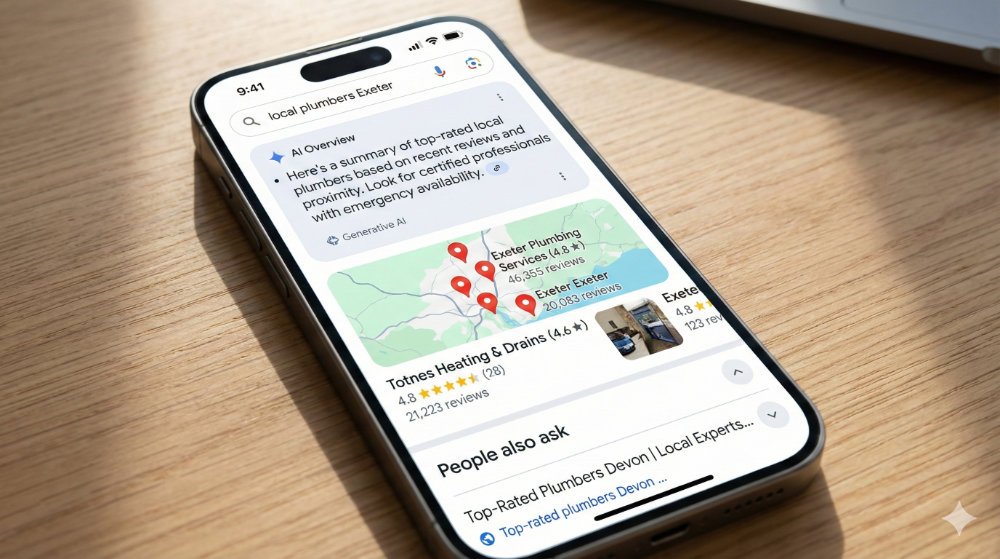
Google’s own data shows that nearly a large number of searches now end without a click to any website. For commercial queries like “plumber near me” or “best accountant in Exeter,” users see AI-generated answers, map results with reviews, and business profiles before they reach traditional organic listings.
Paid results increasingly occupy premium space on the results page too, but for many local searches they now sit alongside AI summaries and Maps rather than replacing them.
Your website is still essential, but it now functions as the foundation for visibility across multiple surfaces rather than the destination itself.
Three specific changes that reshaped local search
1. AI Overviews became the new position zero
In March 2025, Google expanded AI Overviews to commercial and local queries. Search for “electrician in Totnes” and you’ll now see:
- An AI-generated summary of what to look for
- 2 to 3 suggested businesses pulled from Maps and reviews
- A map panel
- Traditional organic results, but below the fold on mobile
One of my clients, a Devon-based heritage organisation, saw their click-through rate drop 25% despite maintaining the same keyword rankings.
Their visibility didn’t disappear – it moved. The information people now want now appears in AI Overview citations and Maps results, but traffic patterns changed completely.
2. Google Business Profiles became more valuable than website rankings
User studies have found a significant share of local clicks go to the Map Pack/Business Profiles (for example, 42% in one task?based study).
For Devon’s tourism and hospitality businesses, this matters enormously. A holiday cottage in Salcombe with a well-maintained Business Profile, 50+ reviews, and correct seasonal hours will outperform a competitor with better website SEO but an incomplete profile.
The search engine is no longer primarily directing traffic to websites. It’s answering questions and facilitating actions directly on the results page.
3. Entity recognition replaced keyword targeting
Google’s December 2025 core update heavily weighted “entity understanding” – how clearly the search engine recognises your business as a distinct, trustworthy entity.
Practically, this means:
- A business mentioned consistently across your website, Google Business Profile, industry directories, and local citations gets more visibility
- Schema markup (structured data that tells search engines who you are, what you do, and where you operate) moved from “nice to have” to essential
- Inconsistent NAP (name, address, phone number) across platforms actively hurts visibility
We audited a East Devon-based Construction company in November and found multiple variations of their business name across directories. After consolidating to one consistent identity and implementing proper schema markup, their Maps visibility improved measurably within six weeks.
What this means for Devon businesses specifically
Devon’s economy is heavily weighted towards tourism, hospitality, professional services, and trades which are all sectors where local search is critical.
Three local factors make these changes particularly relevant:
Seasonal volatility: Tourism businesses in areas like Dartmouth and Woolacombe need to appear in AI summaries during planning season (January to April). If your Business Profile doesn’t reflect accurate seasonal hours or recent reviews, you’re invisible when it matters most.
Geographic spread: Devon’s rural geography means many businesses serve multiple small towns. Entity clarity becomes harder when you’re trying to appear for “plumber in Honiton” and “plumber in Axminster.” Structured data that clearly defines service areas is no longer optional.
Mobile dependency: A VisitDevon 2024 poll of visitors to Devon found that 71% favoured mobile?friendly solutions for planning their trips. On a phone, AI Overviews and Maps results occupy the entire first screen. If you’re not visible there, you effectively don’t exist.
The gap between what businesses are doing and what actually works
Most Devon businesses we talk to are still focused on:
- Keyword rankings
- Website traffic
- “Page one” visibility
Meanwhile, their customers are:
- Getting answers from AI summaries
- Calling directly from Maps results
- Reading reviews before ever visiting a website
This gap creates opportunity. Businesses that align their strategy with how search actually functions in 2026 can achieve visibility their competitors miss entirely.
What actually works now: four practical priorities
Based on client work throughout 2025, the businesses that maintained or improved visibility did four things consistently:
1. Treated their Google Business Profile as seriously as their website
This means:
- Weekly post updates (especially for seasonal or time-sensitive businesses)
- Responding to every review within 48 hours
- Adding photos monthly
- Ensuring hours, services, and attributes stay current
2. Implemented comprehensive schema markup
This sounds technical, but it’s straightforward. Schema tells search engines:
- You’re a registered business (LocalBusiness schema)
- Your service areas (we worked with a Barnstaple heating engineer to properly mark their 25-mile radius)
- Your actual services (not just keywords – structured, machine-readable descriptions)
- Your relationship to reviews, staff, and location
Schema does not magically push a site up the rankings on its own. What it does is far more important in modern search: it helps Google, Maps, and AI-driven answer engines correctly identify, trust, and surface your business as a real-world entity.
In an era of AI Overviews and zero-click results, schema is no longer about chasing rich snippets. It is about establishing clear business identity, strengthening entity recognition, and ensuring your company is eligible to appear wherever answers, recommendations, and local results are being generated.
3. Built consistent citations across key directories
This isn’t about building hundreds of directory links (that hasn’t worked since 2018). It’s about ensuring your business exists consistently on the 15 to 20 directories that actually matter for your sector:
- For trades: Checkatrade, TrustATrader, Which? Trusted Traders, Rated People
- For hospitality: TripAdvisor, Booking.com, VisitDevon, LateRooms
- For professional services: Yell, Thomson Local, local chamber of commerce listings
Consistent name, address, phone number, and website across these platforms reinforces entity recognition. Inconsistency creates confusion that actively hurts visibility.
4. Created content that AI summaries cite
This is where traditional SEO still matters, but differently. AI Overviews cite sources. The businesses that appear in those citations tend to have:
- Clear, well-structured service pages (proper headings, concise descriptions)
- FAQ sections that directly answer common questions
- Local expertise content (a Totnes cafe that wrote about local food suppliers got cited in “best cafes Totnes”)
You’re not optimising for clicks anymore. You’re optimising to be cited, referenced, and included in AI-generated answers.
What 2026 looks like from here
I call this new reality "Search Everywhere Optimisation." It's the shift from trying to rank a single website to ensuring your business is visible, credible, and cited wherever your customer is looking.
Three trends are already driving this for the year ahead:
Voice and AI assistants will increase zero-click searches further: ChatGPT, Claude, and Google’s Gemini are being integrated into search. Businesses that are clear entities with strong structured data will be recommended. Those that aren’t won’t exist to AI assistants.
Reviews will matter more, not less: As AI systems rely on reputation signals to make recommendations, the quality and recency of reviews becomes a core ranking factor. A business with 50 reviews from 2023 will lose to one with 30 reviews from the past six months.
The “website as brochure” model is ending: Your website needs to be fast, secure, mobile-optimised, and structured for machines as much as humans. A beautiful site that loads slowly or lacks proper schema is invisible to AI systems.
What to do next
If you’re a Devon business owner reading this and wondering where you stand, here’s a practical 30-minute audit you can do yourself and is is the same visibility checklist I use at the start of every client audit.:
- Search for your primary service + location (e.g., “accountant Exeter”)
- Do you appear in the AI Overview or its citations?
- Do you appear in the Maps results with recent reviews?
- Click on your Google Business Profile. Is everything current and complete?
- Search for your business name across Google, Bing, and 2 to 3 directories. Is your NAP consistent?
If the answer to any of these is no, you have specific, fixable visibility problems that are costing you customers right now.
Book a search visibility audit
If you want a complete picture of how your business appears across organic results, AI summaries, Maps, and key directories and a prioritised plan for what to fix first book a 30-minute strategy call.
I’ll walk through exactly where you’re visible, where you’re not, and what’s worth doing in the first quarter of 2026.
Book a free discovery call and find out what's possible.More Digital Marketing Articles

DJ Haggett Client Story: 15 Years of SEO and Website Strategy for a Premium Devon Caterer
Added: 16 February 2026
DJ Haggett has stayed at the top of Devon's premium catering market for over 15 years through ongoing website development, SEO, and digital strategy designed to protect visibility and drive consistent bookings.

Beyond the rank: the quiet SEO signals that convert
Added: 13 February 2026
Most SEO advice focuses on what helps you rank with very little talk about what makes someone choose you once you appear. This is the gap is where many enquiries are lost.

SEO consultant Devon: what actually happens week by week
Added: 22 January 2026
If you hire an SEO consultant in Devon, the work should be structured, transparent, and grounded in the realities of the local market. The early weeks focus on fixing technical foundations and removing blockers. After that, the emphasis shifts to local relevance, clearer page intent, and compounding visibility across both traditional search results and AI-driven summaries.

Schema is not SEO snake oil, but is it actually worth doing
Added: 06 January 2026
Structured data (schema markup) occupies an awkward middle ground in SEO. It is often oversold as a ranking booster, then dismissed entirely when no uplift appears. Neither position survives contact with the evidence. Schema does not directly improve rankings. It also does not do 'nothing'. Its value lies in a narrow but increasingly relevant set of use cases, especially as search interfaces shift toward summarisation, extraction, and entity-based retrieval.

Client Story: On Point Construction
Added: 07 December 2025
On Point Construction is a high quality building company in Exmouth led by Rob and Nick. They partnered with 1010 Media to improve visibility, attract stronger enquiries and ensure their website reflects the standard of their work. The project included a full website update, complete copy rewrite, on page optimisation and local SEO and continues with the 1010 Media Growth Package, a monthly optimisation plan designed to increase rankings, engagement and enquiry volume over time.

Matomo vs GA4: The analytics decision UK businesses must make
Added: 04 December 2025
UK businesses need dependable analytics to guide SEO and marketing decisions. The choice between Google Analytics 4 and Matomo Analytics comes down to competing priorities: ecosystem integration versus data ownership and control. Neither platform is objectively superior. Your choice depends on your business model, budget, and regulatory requirements.