


Email marketing: the king is dead, long live the king
By: Andy Chapman | Published: 24 November 2025
Email is not outdated, it is the only digital channel where you fully own the relationship with your audience. While social algorithms and AI search shift visibility, email delivers predictable ROI and higher conversion rates. Stop renting your traffic. Start building a segmented, automated list that drives revenue on your terms.
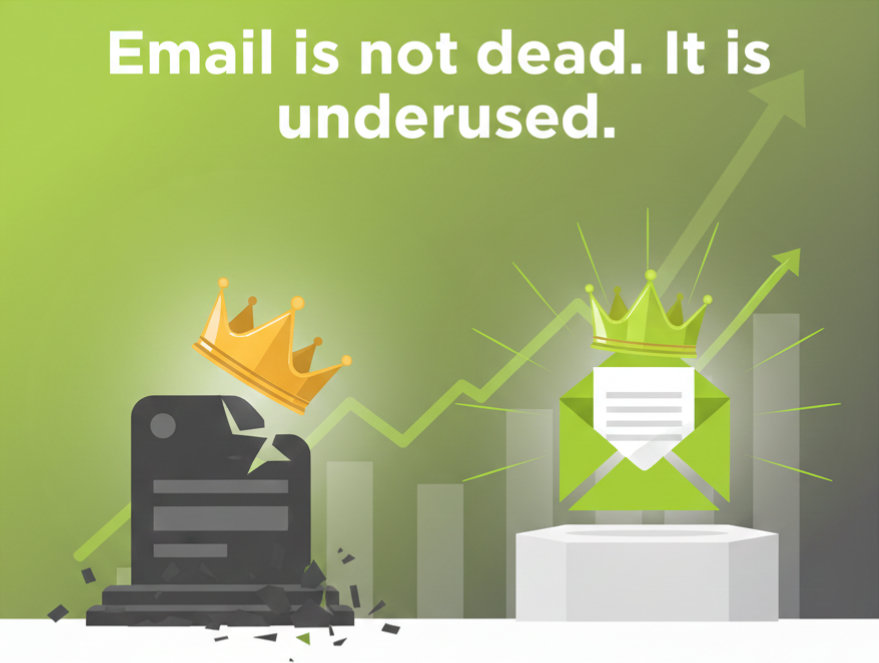
Why owned marketing channels matter more than ever
For years, marketers have chased the next big platform. First it was Facebook reach, then Instagram engagement, and now TikTok trends. But while businesses were busy trying to go viral, email kept quietly outperforming every other channel.
The landscape is changing again. With the rise of AI Overviews and generative search, organic traffic is becoming more volatile. Social media reach is increasingly "pay to play." In this environment, an email list is your insurance policy. It is a direct line to your customers that no algorithm update can sever.
For a small business in Devon or a national organisation, the math is simple: you own the list, you own the asset. Relying solely on third party platforms means building your house on rented land.
The mechanics of conversion
Email wins on performance because it is permission based. These people asked to hear from you. That intent translates into data we can track and revenue we can bank.
When you send a campaign, you are not shouting into a void you are starting a conversation in a private inbox. This allows for:
- Hyper personalisation: Sending offers based on past purchases, not just demographics.
- Automation: Nurturing leads while you sleep with welcome sequences and abandoned cart flows.
- Retention: Keeping your brand top of mind without paying for retargeting ads.
What good email marketing looks like
Modern email marketing is not about blasting a generic newsletter to everyone you have ever met. It is about segmentation and relevance.
Good email strategy looks like this:
- Clean data: Removing inactive subscribers to protect your deliverability rates.
- Value first: Sending helpful content (answers, guides, insights) 80% of the time, and sales offers 20% of the time.
- Mobile optimisation: Ensuring every email looks perfect on a phone screen, where most opens happen.
Do this next
If you have neglected your list, here is how to restart the engine.
- Audit your capture forms: Are you giving people a reason to sign up beyond "join our newsletter"? Offer a lead magnet or a discount.
- Clean your list: Run your database through a cleaning tool to remove hard bounces. This improves your sender reputation.
- Set up a welcome flow: Write a simple 3 part series that introduces your brand, delivers value, and sets expectations.
- Segment your audience: Split your list into "prospects" and "customers." Speak to them differently.
- Send one broadcast this week: Keep it text based, personal, and focused on solving one specific problem.
How to measure the success of email marketing
Forget vanity metrics, here is what pays the bills:
Email is the workhorse of digital marketing. It is not flashy, but it works. While competitors waste budget chasing the latest trend, you can build a predictable revenue stream that belongs entirely to you.
Book a free discovery call to see how this could work for your business.
Book a free discovery call and find out what's possible.More Digital Marketing Articles

Google's March 2026 core update: what Devon businesses should do next
Added: 12 April 2026
Google's March 2026 core update finished rolling out on 8 April. It rewards pages that show real experience, match search intent tightly, and go deep on a topic. It downgrades thin, generic content regardless of how polished the writing looks. For Devon small businesses, the action plan is simple. Show your work, prove you serve this area, and refresh tired pages before publishing new ones.

DJ Haggett Client Story: 15 Years of SEO and Website Strategy for a Premium Devon Caterer
Added: 16 February 2026
DJ Haggett has stayed at the top of Devon's premium catering market for over 15 years through ongoing website development, SEO, and digital strategy designed to protect visibility and drive consistent bookings.

Beyond the rank: the quiet SEO signals that convert
Added: 13 February 2026
Most SEO advice focuses on what helps you rank with very little talk about what makes someone choose you once you appear. This is the gap is where many enquiries are lost.

SEO consultant Devon: what actually happens week by week
Added: 22 January 2026
If you hire an SEO consultant in Devon, the work should be structured, transparent, and grounded in the realities of the local market. The early weeks focus on fixing technical foundations and removing blockers. After that, the emphasis shifts to local relevance, clearer page intent, and compounding visibility across both traditional search results and AI-driven summaries.

Schema is not SEO snake oil, but is it actually worth doing
Added: 06 January 2026
Structured data (schema markup) occupies an awkward middle ground in SEO. It is often oversold as a ranking booster, then dismissed entirely when no uplift appears. Neither position survives contact with the evidence. Schema does not directly improve rankings. It also does not do 'nothing'. Its value lies in a narrow but increasingly relevant set of use cases, especially as search interfaces shift toward summarisation, extraction, and entity-based retrieval.

What changed in Local Search in 2025 and what Devon Businesses should do about it
Added: 29 December 2025
2025 fundamentally changed how customers find local businesses. Google's AI Overviews now appear in a majority of commercial searches, traditional organic listings have moved down the page, and well over half of searches now end without a click. For Devon businesses, the old playbook of 'rank higher, get more traffic' no longer reflects how search actually works. Here's what happened, what it means, and what to do next.